


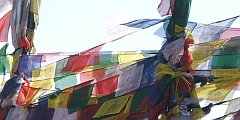
Colours of Holi
(vero;2017-August-06)
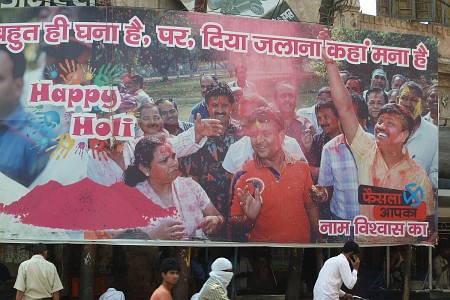 Holi is an important festival in the Hindu calendar. To me it is very reminiscent of the European Carnival celebrations, especially the German Fastnacht. They all celebrate the passing of winter and are an occasion for throwing social and other constraints over board.
In Europe, people wear disguise, hide behind masks and have fun, behaving in ways which they would never do on “normal” occasions. Alcohol flows freely, inhibitions disappear and it seems a free for all. People who snub you during the year suddenly behave in too familiar ways just because they can get away with it. Yes you might have guessed, I am not a lover of Carnival or Fastnacht, although I see its historical significance and like the ideas behind it: it marked the end of Lent and its privations and coincided with the coming of spring which is indeed a reason to celebrate. Furthermore in the past, when freedom of speech was not existent, it was a welcome outlet for accumulated grievances and frustrations. But all this is not really valid anymore nowadays and what remains is not something that I enjoy.
So, what about Holi, the festival of colours then? It is a religious festival and as I looked for its origins, I found following legend:
There was once a king named Hiranyakashipu who wanted to gain supernatural powers in order to become a mighty and feared ruler over the world. To do so, he set on performing great penance in order to trick Brahma (the creator-God) in granting him these powers. Impressed by so much devotion, Brahma eventually rewarded him by granting him one wish and the king asked from the God that he should not get death either on earth or in space, either in fire or in water, either during daytime or during nighttime, either by humans or by gods or by any species, either by the animate or by inanimate, either inside the house or outside the house..
 This made the king practically invincible and he soon ordered people in his kingdom to worship him as a God. Everyone obeyed with the exception of his own son Prahlad who remained devoted to Vishnu.
Hiranyakashipu took great offence and decided to kill the young boy. He asked his sister Holika for help: she was to trick her nephew to sit on her lap while in fact sitting on a pyre. Protected by a magic shawl given to her by Brahma, she was to survive the fire while the boy burnt to death. When the fire started, Prahlad prayed Vishnu to save him and so did the God: the shawl flew magically from Holika to Prahlad who survived unharmed while she was burnt alive.
Then Vishnu appeared and killed Hiranyakashipu. Doing this, he took care not to break Brahma's promise: he appeared in the form of a Narashima (which is neither human nor animal), during twilight time (which is neither day nor night), placing him on his thighs (which means neither on earth nor in space) on the threshold of the court hall (which is neither indoors nor outdoors) using his claws as weapons (which are neither animate nor inanimate).
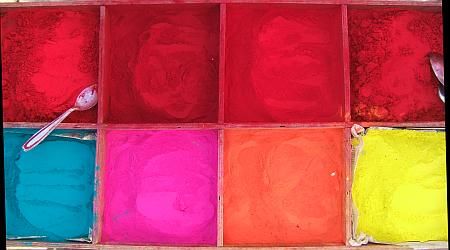
As a reminder of Holika's fate, public bonfires are lit on the day before the Holi celebrations can start (in Kathmandu in front of the old royal palace). On the following morning, people (not only Hindus) go about in the streets and splash each others with coloured powders and water before finishing the day with visits to family and friends.
We have been thrice in Asia during Holi and for us foreigners, all we see and experience is the colour splashing in the streets. There is no way to escape and we have learnt to wear old tee-shirts and clothes on that day. Unfortunately, what starts as happy banter often degenerates and we end up as a welcome target.
I remember one Holi-day in 2008: we had a good time watching the people enjoying themselves in Kathmandu, got splashed as well, all in good humour. Later in the day, we made our way to Bodnath and came under fire as we were spotted by a group of teenagers throwing powders, water bombs and getting a bit too close and aggressive to our taste. Since then, we are a bit wary of Holi and if we happen to be in country on that day, we keep our distance.
$ updated from: Background.htxt Sun 24 May 2026 15:57:32 trvl2 — Copyright © 2026 Vero and Thomas Lauer unless otherwise stated | All rights reserved $